WeaveScope review
Observability and debugging platform purpose-built for Elixir-based AI agents and distributed systems.
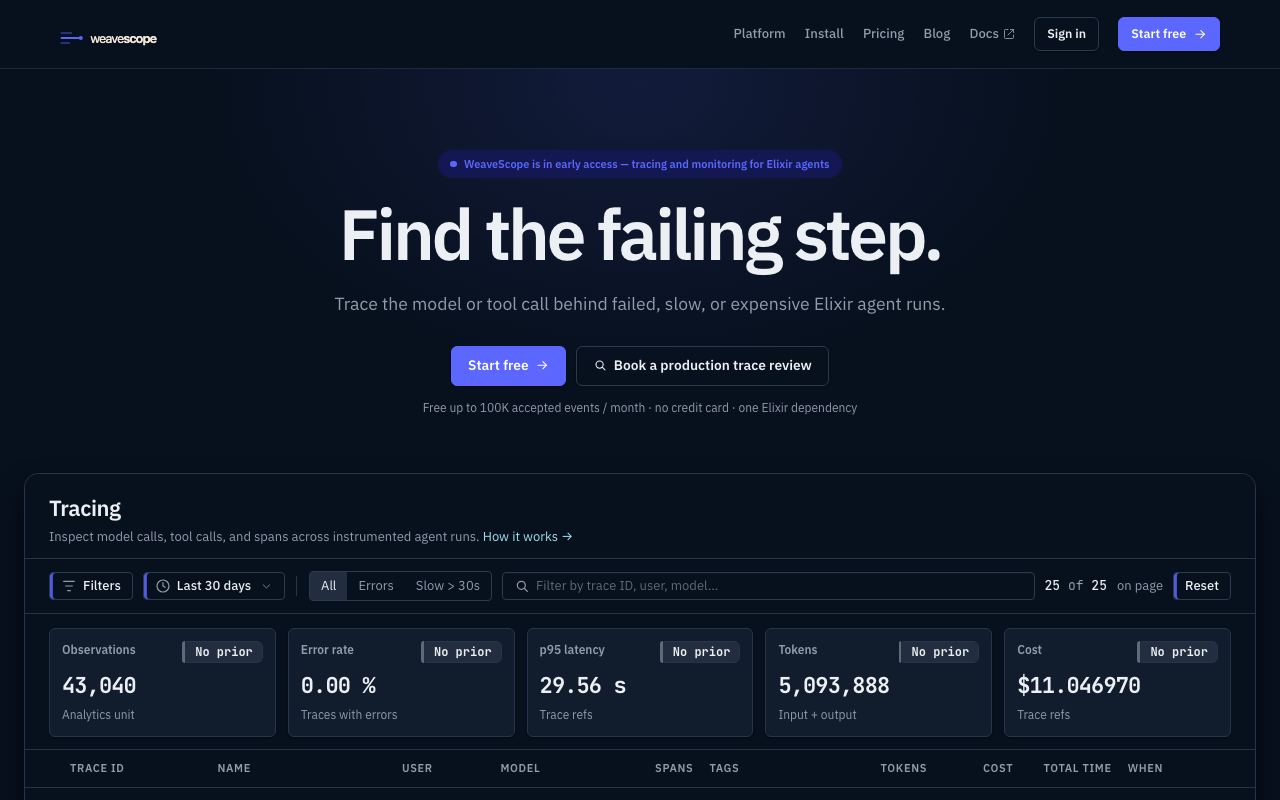
WireTensors rating
Time saved: Estimated to reduce agent debugging time by ~2–3 hours per week for Elixir teams, though no benchmarks are published..
Key facts
| Tool | WeaveScope |
|---|---|
| Category | Coding |
| Pricing | Pricing not publicly listed at time of review |
| Free tier | No |
| WireTensors rating | 3.4 / 5 |
| Best for | Teams building AI agents and distributed systems in Elixir who need native observability for agent reasoning and tool invocations. |
| Avoid if | Your AI agents are built in Python, Node.js, Go, or other mainstream languages, or if you require a language-agnostic observability platform. |
| Affiliate commission | Pending affiliate program review |
| Cookie window | N/A |
| Last verified | 2026-08-15 |
Overview
WeaveScope is a native observability and debugging platform designed for Elixir-based AI agents and distributed systems. The tool specialises in tracing agent reasoning chains, tool invocations, and decision trees across Elixir nodes, helping developers understand why agents made specific decisions and where failures or latency spikes occurred. WeaveScope integrates into Elixir applications using lightweight instrumentation (likely via telemetry hooks) and displays agent execution traces, message flows, and performance metrics in a web dashboard. The platform is built specifically for Elixir and the Erlang/OTP runtime, leveraging the language's strengths in fault-tolerant, concurrent systems. Many AI agent frameworks and distributed systems benefit from Elixir's actor model and supervisor trees, yet existing observability tools (Datadog, New Relic, Honeycomb) are not optimised for agent-specific workflows. WeaveScope fills this gap by providing native instrumentation for agent patterns—tracing decisions, reward signals, tool calls, and rollbacks as they flow through concurrent Elixir processes. WeaveScope emerged from a Show HN post in August 2026 and is in early availability. Pricing, feature tiers, and support models are not yet public. The product targets a small but dedicated audience: Elixir developers building production AI agents, particularly at companies already using Elixir for real-time systems (e.g., fintech, telecommunications, gaming backends). The Elixir AI agent ecosystem is nascent compared to Python or JavaScript, so demand is constrained—but for teams already committed to Elixir, the alternative is either building custom observability or adapting generic APM tools, both of which are painful. Limitations are substantial. Documentation is sparse, and it is unclear how WeaveScope performs under high-cardinality agent state, how it scales to hundreds of concurrent agents, or how it integrates with popular Elixir frameworks and libraries. There are no published benchmarks on storage overhead, query latency, or agent tracing accuracy. Support for multi-tenant deployments, data residency, and compliance with data retention regulations is not detailed.
Pros
- Purpose-built for Elixir, addressing a niche gap in observability tooling for functional AI agent systems
- Designed to trace agent decisions, tool calls, and reasoning chains across distributed Elixir nodes
- Lightweight integration into Elixir codebases without heavy instrumentation overhead
Cons
- Extremely narrow scope—only useful if your AI agents are built on Elixir, a small ecosystem
- No published performance overhead, scalability limits, or compatibility details with popular Elixir frameworks
- Minimal public documentation and no visible case studies or user testimonials
Who it is for
- Best for: Teams building AI agents and distributed systems in Elixir who need native observability for agent reasoning and tool invocations..
- Avoid if: Your AI agents are built in Python, Node.js, Go, or other mainstream languages, or if you require a language-agnostic observability platform..
Who this is for
Elixir developers and teams building production AI agents, particularly those using frameworks like LiveGeneration or custom agent architectures on top of Erlang/OTP. Relevant for teams where tracing agent decisions and tool calls is critical for debugging, auditing, or compliance. Most applicable to organisations already heavily invested in Elixir for real-time, fault-tolerant systems and now adding AI capabilities.
Who should skip this
The vast majority of AI developers, who work in Python, JavaScript, or Go. Also skip if you need a multi-language observability stack or integration with existing APM tools (DataDog, New Relic). Avoid if you lack Elixir expertise in-house or are evaluating Elixir adoption based on AI use cases.
Verdict
WeaveScope is a specialised tool for a small but real subset of developers: Elixir teams building production AI agents. The lack of documentation and early-stage maturity mean it is suitable only for teams with Elixir expertise and a willingness to engage closely with the vendor. Not recommended for teams evaluating Elixir for AI applications, or for any team using mainstream languages.
User reviews
Real reader reviews — separate from WireTensors' own editorial rating above. Every submission is moderated before it appears here.
Loading reviews…
Write a review
WeaveScope FAQ
What is WeaveScope? +
WeaveScope is a native observability and debugging platform designed for Elixir-based AI agents and distributed systems. The tool specialises in tracing agent reasoning chains, tool invocations, and decision trees across Elixir nodes, helping developers understand why agents made specific decisions and where failures or latency spikes occurred. WeaveScope integrates into Elixir applications using lightweight instrumentation (likely via telemetry hooks) and displays agent execution traces, message flows, and performance metrics in a web dashboard. The platform is built specifically for Elixir and the Erlang/OTP runtime, leveraging the language's strengths in fault-tolerant, concurrent systems. Many AI agent frameworks and distributed systems benefit from Elixir's actor model and supervisor trees, yet existing observability tools (Datadog, New Relic, Honeycomb) are not optimised for agent-specific workflows. WeaveScope fills this gap by providing native instrumentation for agent patterns—tracing decisions, reward signals, tool calls, and rollbacks as they flow through concurrent Elixir processes. WeaveScope emerged from a Show HN post in August 2026 and is in early availability. Pricing, feature tiers, and support models are not yet public. The product targets a small but dedicated audience: Elixir developers building production AI agents, particularly at companies already using Elixir for real-time systems (e.g., fintech, telecommunications, gaming backends). The Elixir AI agent ecosystem is nascent compared to Python or JavaScript, so demand is constrained—but for teams already committed to Elixir, the alternative is either building custom observability or adapting generic APM tools, both of which are painful. Limitations are substantial. Documentation is sparse, and it is unclear how WeaveScope performs under high-cardinality agent state, how it scales to hundreds of concurrent agents, or how it integrates with popular Elixir frameworks and libraries. There are no published benchmarks on storage overhead, query latency, or agent tracing accuracy. Support for multi-tenant deployments, data residency, and compliance with data retention regulations is not detailed.
How much does WeaveScope cost? +
WeaveScope pricing: Pricing not publicly listed at time of review. Always confirm current pricing on the official site, as plans change.
Does WeaveScope have a free tier? +
No. WeaveScope does not offer an ongoing free plan, though a trial may be available.
What is WeaveScope best for? +
Teams building AI agents and distributed systems in Elixir who need native observability for agent reasoning and tool invocations..
When should you avoid WeaveScope? +
Avoid WeaveScope if: Your AI agents are built in Python, Node.js, Go, or other mainstream languages, or if you require a language-agnostic observability platform..
What are the main pros of WeaveScope? +
Purpose-built for Elixir, addressing a niche gap in observability tooling for functional AI agent systems; Designed to trace agent decisions, tool calls, and reasoning chains across distributed Elixir nodes; Lightweight integration into Elixir codebases without heavy instrumentation overhead.
What are the main cons of WeaveScope? +
Extremely narrow scope—only useful if your AI agents are built on Elixir, a small ecosystem; No published performance overhead, scalability limits, or compatibility details with popular Elixir frameworks; Minimal public documentation and no visible case studies or user testimonials.
Does WeaveScope have an affiliate program? +
No public affiliate program is listed for WeaveScope at the time of review.
How is WeaveScope rated? +
WireTensors rates WeaveScope 3.4 out of 5, based on capability, value, and fit for its intended use case.
What category does WeaveScope fall under? +
WeaveScope is categorised under coding on WireTensors.
When was this WeaveScope review last verified? +
This review was last verified on 2026-08-15 against the vendor's official site.
Reviewed by Arjun Mehta
Editorial lead overseeing WireTensors' research, sourcing and verification process
Last verified:
Sources
- WeaveScope — official website — verified