TreeSequence review
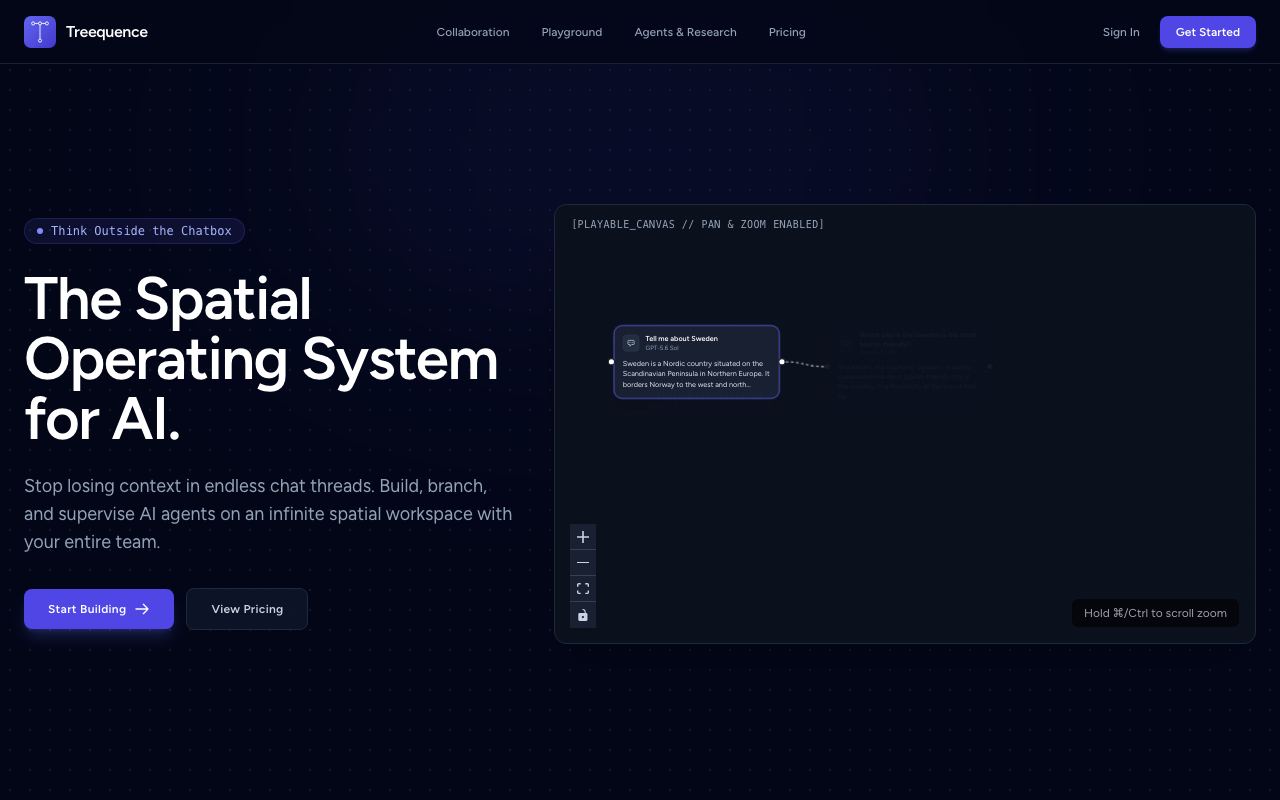
Spatial node canvas to visualise and manage LLM context, preventing context drift in agent workflows.
WireTensors rating
Time saved: Saves ~3–5 hours/week on context management and debugging multi-turn agent failures if effective visualisation prevents information loss; gains depend on workflow complexity..
Key facts
| Tool | TreeSequence |
|---|---|
| Category | Coding |
| Pricing | Pricing not publicly listed at time of review |
| Free tier | Yes |
| WireTensors rating | 3.5 / 5 |
| Best for | Developers building multi-step AI agents or long-context workflows where preserving reasoning state and avoiding repetition is critical. |
| Avoid if | You are using simple single-turn LLM queries or have no need to visualise or manage conversation history. |
| Affiliate commission | Pending affiliate program review |
| Cookie window | N/A |
| Last verified | 2026-08-15 |
Overview
TreeSequence is a web-based spatial node canvas designed to help developers visualise, structure, and manage LLM context in multi-turn agent workflows. Launched as a Show HN project (4 pts), it addresses a documented problem in AI agent development: as tasks span multiple LLM calls, context can degrade, older reasoning gets deprioritised, or key facts are forgotten—leading to inefficient re-prompting or task failure. TreeSequence allows users to build a node graph where each node represents a distinct piece of context, reasoning state, or a specific LLM call; edges define dependencies and flow. This visual representation helps developers identify which context is active at each step, spot where drift occurs, and restructure prompts to prevent information loss. The tool is accessed via treequence.ai and is offered with a free tier; pricing for premium features is not yet disclosed. Under the hood, TreeSequence likely uses a graph database or structured state machine to represent the context tree, with integrations (if any) to LLM APIs such as OpenAI or Anthropic. It does not implement its own LLM; instead, it acts as a management layer. Comparable tools include LangChain's UI (focused on prototyping), Langraph (programmatic state management), and Relevance AI (visual agent builder with less emphasis on context visualisation). TreeSequence's strength lies in spatial, node-based context visualisation rather than code-first orchestration or no-code automation. Main limitations include uncertain integration depth with popular LLM frameworks, sparse documentation for new users, and unvalidated claim about efficacy in preventing context drift at scale. The lack of published case studies or benchmarks means real-world impact remains anecdotal.
Pros
- Addresses a real pain point: LLM context loss and drift in multi-turn agent tasks
- Visual node-based interface makes complex context hierarchies intuitive
- Show HN support suggests product-market fit signals in developer community (4 pts)
Cons
- Unproven integration with existing LLM platforms and frameworks
- Early-stage with limited documentation and examples
- No clear business model or enterprise support pathway disclosed
Who it is for
- Best for: Developers building multi-step AI agents or long-context workflows where preserving reasoning state and avoiding repetition is critical..
- Avoid if: You are using simple single-turn LLM queries or have no need to visualise or manage conversation history..
Who this is for
TreeSequence targets software engineers and AI/ML teams building agentic systems—such as multi-step automation workflows, complex research pipelines, or iterative code generation tasks. Developers frustrated by LLM context windows resetting or losing prior reasoning will find the spatial canvas approach valuable. Teams experimenting with ReAct, Chain of Thought, or other multi-turn agent patterns are likely candidates. Researchers studying LLM reasoning and memory management may also benefit from its visualisation.
Who should skip this
Casual chatbot users, teams using only single-turn LLM calls, and those satisfied with linear conversation logs should not prioritise TreeSequence. Non-technical stakeholders and organisations without dedicated AI engineering teams may find the interface too specialised. Those requiring out-of-the-box, no-code agent builders should explore platforms like LangChain Studio, Relevance AI, or Make instead.
Verdict
TreeSequence tackles a genuine pain point in AI agent development through novel spatial context visualisation. The early-stage product shows promising conceptual signals but lacks proof of efficacy and clear integration pathways. Worth exploring for teams actively building complex multi-turn LLM workflows; too experimental for mission-critical deployments.
User reviews
Real reader reviews — separate from WireTensors' own editorial rating above. Every submission is moderated before it appears here.
Loading reviews…
Write a review
TreeSequence FAQ
What is TreeSequence? +
TreeSequence is a web-based spatial node canvas designed to help developers visualise, structure, and manage LLM context in multi-turn agent workflows. Launched as a Show HN project (4 pts), it addresses a documented problem in AI agent development: as tasks span multiple LLM calls, context can degrade, older reasoning gets deprioritised, or key facts are forgotten—leading to inefficient re-prompting or task failure. TreeSequence allows users to build a node graph where each node represents a distinct piece of context, reasoning state, or a specific LLM call; edges define dependencies and flow. This visual representation helps developers identify which context is active at each step, spot where drift occurs, and restructure prompts to prevent information loss. The tool is accessed via treequence.ai and is offered with a free tier; pricing for premium features is not yet disclosed. Under the hood, TreeSequence likely uses a graph database or structured state machine to represent the context tree, with integrations (if any) to LLM APIs such as OpenAI or Anthropic. It does not implement its own LLM; instead, it acts as a management layer. Comparable tools include LangChain's UI (focused on prototyping), Langraph (programmatic state management), and Relevance AI (visual agent builder with less emphasis on context visualisation). TreeSequence's strength lies in spatial, node-based context visualisation rather than code-first orchestration or no-code automation. Main limitations include uncertain integration depth with popular LLM frameworks, sparse documentation for new users, and unvalidated claim about efficacy in preventing context drift at scale. The lack of published case studies or benchmarks means real-world impact remains anecdotal.
How much does TreeSequence cost? +
TreeSequence pricing: Pricing not publicly listed at time of review. Always confirm current pricing on the official site, as plans change.
Does TreeSequence have a free tier? +
Yes. TreeSequence offers a free plan or free credits you can use to evaluate it.
What is TreeSequence best for? +
Developers building multi-step AI agents or long-context workflows where preserving reasoning state and avoiding repetition is critical..
When should you avoid TreeSequence? +
Avoid TreeSequence if: You are using simple single-turn LLM queries or have no need to visualise or manage conversation history..
What are the main pros of TreeSequence? +
Addresses a real pain point: LLM context loss and drift in multi-turn agent tasks; Visual node-based interface makes complex context hierarchies intuitive; Show HN support suggests product-market fit signals in developer community (4 pts).
What are the main cons of TreeSequence? +
Unproven integration with existing LLM platforms and frameworks; Early-stage with limited documentation and examples; No clear business model or enterprise support pathway disclosed.
Does TreeSequence have an affiliate program? +
No public affiliate program is listed for TreeSequence at the time of review.
How is TreeSequence rated? +
WireTensors rates TreeSequence 3.5 out of 5, based on capability, value, and fit for its intended use case.
What category does TreeSequence fall under? +
TreeSequence is categorised under coding on WireTensors.
When was this TreeSequence review last verified? +
This review was last verified on 2026-08-15 against the vendor's official site.
Reviewed by Arjun Mehta
Editorial lead overseeing WireTensors' research, sourcing and verification process
Last verified:
Sources
- TreeSequence — official website — verified