Traceseal review
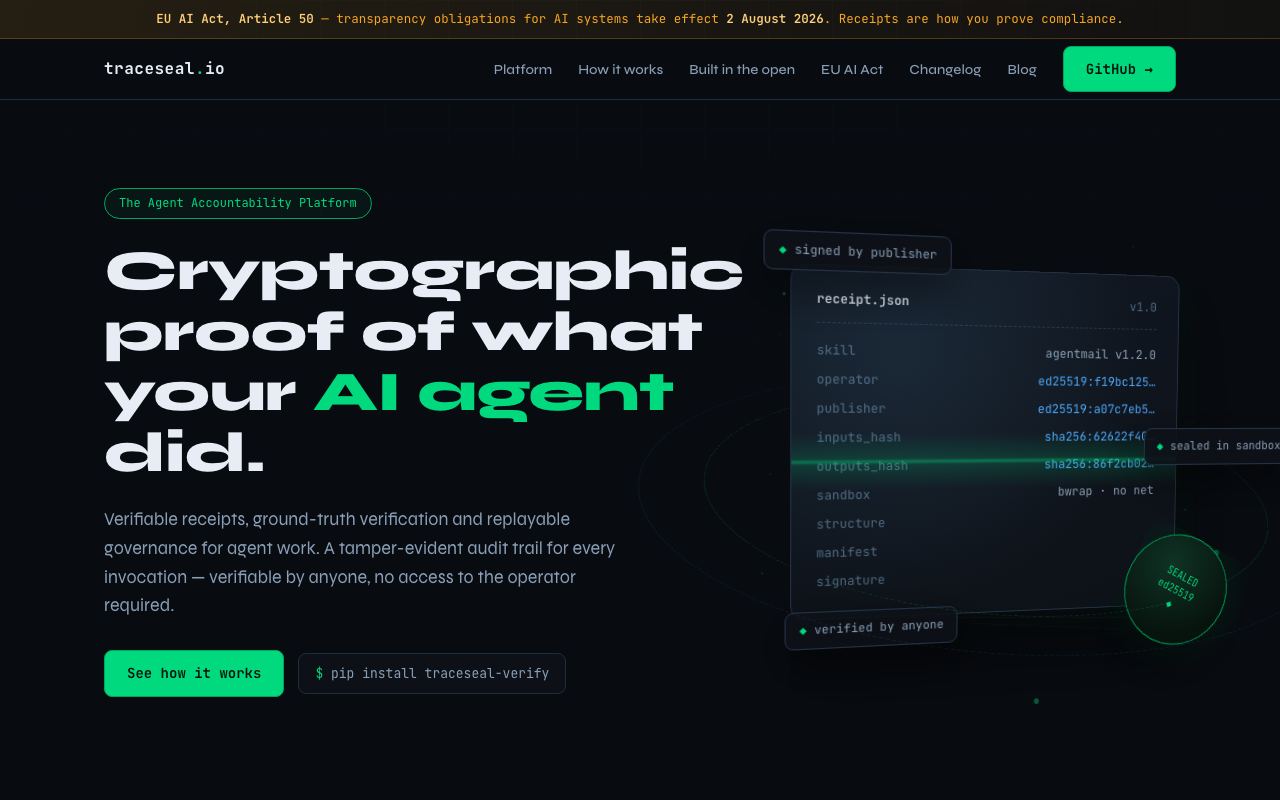
A cryptographic audit system that generates signed, offline-verifiable receipts for AI agent executions.
WireTensors rating
Time saved: Saves 10–20 hours per month on manual log review and compliance reporting for organisations currently relying on unverified logs or third-party audit vendors..
Key facts
| Tool | Traceseal |
|---|---|
| Category | Productivity |
| Pricing | Pricing not publicly listed at time of review |
| Free tier | Yes |
| WireTensors rating | 3.9 / 5 |
| Best for | Organisations deploying autonomous agents in regulated industries (finance, healthcare, legal) where audit trails, compliance reporting, and forensic investigation of agent behaviour are legally or operationally critical. |
| Avoid if | You are building low-stakes internal tools where agent transparency is not a regulatory requirement, or if your infrastructure does not support third-party audit integrations and custom logging pipelines. |
| Affiliate commission | Pending affiliate program review |
| Cookie window | N/A |
| Last verified | 2026-08-11 |
Overview
Traceseal is a cryptographic audit and verification system for AI agent executions, launched on Hacker News Show HN in August 2026. The tool addresses a growing problem in autonomous AI systems: as agents make decisions on behalf of humans—executing trades, modifying records, contacting third parties—organisations need proof that the agent acted correctly and received proper authorisation. Traditional approaches rely on centralised audit logs, which are opaque to external stakeholders and can be altered. Traceseal's innovation is to generate signed cryptographic receipts for agent runs, analogous to blockchain-style proof of execution, allowing anyone with a public key to verify offline that a specific agent action occurred as claimed. The underlying mechanism likely uses public-key cryptography and hash-chain techniques similar to Merkle trees or transparency logs, ensuring that a receipt cannot be forged without detection. The tool is agent-agnostic, designed to integrate with existing autonomous systems through logging middleware or SDK-style integrations. Traceseal does not control the agent itself; rather, it observes the agent's actions and generates tamper-evident receipts summarising inputs, outputs, and outcomes. This design preserves agent autonomy while providing third-party auditing capability. No pricing has been announced, though the Show HN submission and early-stage status suggest either a freemium model or commercial licensing for enterprises. Use cases span regulated industries: financial institutions can prove to regulators that trading agents acted within risk parameters, healthcare systems can demonstrate that diagnostic agents followed approved protocols, and legal firms can evidence that contract-analysis agents did not leak confidential information. Compared to vendor-provided audit logs (from OpenAI, Anthropic, or others), Traceseal offers independence: stakeholders do not need to trust the vendor's logs. Compared to blockchain-based approaches, Traceseal is lightweight and does not require distributed consensus. Key limitations include dependency on agent integration (agents must be instrumented to produce loggable outputs), potential performance overhead during agent execution, and the need for stakeholders to understand cryptographic verification—a technical barrier for non-security teams.
Pros
- Provides cryptographic proof of agent actions without requiring centralised trust, valuable for compliance and forensic auditing of autonomous systems
- Offline verifiability allows stakeholders to validate agent behaviour without accessing proprietary logs or servers
- Designed with security-first architecture, addressing growing regulatory and organisational need for auditable agent behaviour in high-stakes domains
Cons
- Adoption depends on agent and platform support; without native integration, Traceseal is limited to log-based auditing after the fact
- Cryptographic verification complexity may exceed technical expertise of non-security teams, limiting practical adoption despite strong conceptual appeal
- No published information on performance overhead, integration APIs, or compatibility with existing agent frameworks limits ability to assess deployment feasibility
Who it is for
- Best for: Organisations deploying autonomous agents in regulated industries (finance, healthcare, legal) where audit trails, compliance reporting, and forensic investigation of agent behaviour are legally or operationally critical..
- Avoid if: You are building low-stakes internal tools where agent transparency is not a regulatory requirement, or if your infrastructure does not support third-party audit integrations and custom logging pipelines..
Who this is for
Traceseal is designed for compliance officers, security teams, and architects responsible for deploying AI agents in regulated environments. It suits financial institutions, healthcare providers, and legal firms where agent actions must be auditable and defensible in regulatory review or litigation. Risk and governance teams building internal controls for autonomous systems will also find cryptographic receipts valuable for incident investigation and post-hoc accountability.
Who should skip this
Internal teams building proof-of-concept agents, organisations without regulatory pressure for agent auditing, and teams lacking cryptographic expertise or on-premises infrastructure should skip this tool. It is also unsuitable for rapid experimentation or low-risk use cases where audit overhead exceeds operational value.
Verdict
Traceseal addresses a genuine and growing pain point in regulated agent deployment, offering a novel technical approach to independent auditability. Its cryptographic foundation is sound, and the use case is compelling. However, integration requirements, lack of published performance data, and niche applicability mean it is best suited to security-first organisations rather than general productivity.
User reviews
Real reader reviews — separate from WireTensors' own editorial rating above. Every submission is moderated before it appears here.
Loading reviews…
Write a review
Traceseal FAQ
What is Traceseal? +
Traceseal is a cryptographic audit and verification system for AI agent executions, launched on Hacker News Show HN in August 2026. The tool addresses a growing problem in autonomous AI systems: as agents make decisions on behalf of humans—executing trades, modifying records, contacting third parties—organisations need proof that the agent acted correctly and received proper authorisation. Traditional approaches rely on centralised audit logs, which are opaque to external stakeholders and can be altered. Traceseal's innovation is to generate signed cryptographic receipts for agent runs, analogous to blockchain-style proof of execution, allowing anyone with a public key to verify offline that a specific agent action occurred as claimed. The underlying mechanism likely uses public-key cryptography and hash-chain techniques similar to Merkle trees or transparency logs, ensuring that a receipt cannot be forged without detection. The tool is agent-agnostic, designed to integrate with existing autonomous systems through logging middleware or SDK-style integrations. Traceseal does not control the agent itself; rather, it observes the agent's actions and generates tamper-evident receipts summarising inputs, outputs, and outcomes. This design preserves agent autonomy while providing third-party auditing capability. No pricing has been announced, though the Show HN submission and early-stage status suggest either a freemium model or commercial licensing for enterprises. Use cases span regulated industries: financial institutions can prove to regulators that trading agents acted within risk parameters, healthcare systems can demonstrate that diagnostic agents followed approved protocols, and legal firms can evidence that contract-analysis agents did not leak confidential information. Compared to vendor-provided audit logs (from OpenAI, Anthropic, or others), Traceseal offers independence: stakeholders do not need to trust the vendor's logs. Compared to blockchain-based approaches, Traceseal is lightweight and does not require distributed consensus. Key limitations include dependency on agent integration (agents must be instrumented to produce loggable outputs), potential performance overhead during agent execution, and the need for stakeholders to understand cryptographic verification—a technical barrier for non-security teams.
How much does Traceseal cost? +
Traceseal pricing: Pricing not publicly listed at time of review. Always confirm current pricing on the official site, as plans change.
Does Traceseal have a free tier? +
Yes. Traceseal offers a free plan or free credits you can use to evaluate it.
What is Traceseal best for? +
Organisations deploying autonomous agents in regulated industries (finance, healthcare, legal) where audit trails, compliance reporting, and forensic investigation of agent behaviour are legally or operationally critical..
When should you avoid Traceseal? +
Avoid Traceseal if: You are building low-stakes internal tools where agent transparency is not a regulatory requirement, or if your infrastructure does not support third-party audit integrations and custom logging pipelines..
What are the main pros of Traceseal? +
Provides cryptographic proof of agent actions without requiring centralised trust, valuable for compliance and forensic auditing of autonomous systems; Offline verifiability allows stakeholders to validate agent behaviour without accessing proprietary logs or servers; Designed with security-first architecture, addressing growing regulatory and organisational need for auditable agent behaviour in high-stakes domains.
What are the main cons of Traceseal? +
Adoption depends on agent and platform support; without native integration, Traceseal is limited to log-based auditing after the fact; Cryptographic verification complexity may exceed technical expertise of non-security teams, limiting practical adoption despite strong conceptual appeal; No published information on performance overhead, integration APIs, or compatibility with existing agent frameworks limits ability to assess deployment feasibility.
Does Traceseal have an affiliate program? +
No public affiliate program is listed for Traceseal at the time of review.
How is Traceseal rated? +
WireTensors rates Traceseal 3.9 out of 5, based on capability, value, and fit for its intended use case.
What category does Traceseal fall under? +
Traceseal is categorised under productivity on WireTensors.
When was this Traceseal review last verified? +
This review was last verified on 2026-08-11 against the vendor's official site.
Reviewed by Arjun Mehta
Editorial lead overseeing WireTensors' research, sourcing and verification process
Last verified:
Sources
- Traceseal — official website — verified