SendPage review
Convert AI-generated HTML into shareable links without hosting infrastructure or manual deployment.
WireTensors rating
Time saved: Saves approximately 1–2 hours per project by eliminating manual HTML file hosting and deployment configuration for prototype sharing..
Key facts
| Tool | SendPage |
|---|---|
| Category | Productivity |
| Pricing | Pricing not publicly listed at time of review |
| Free tier | Yes |
| WireTensors rating | 3.7 / 5 |
| Best for | Marketers, copywriters, and designers who need to rapidly prototype and share AI-generated landing pages, email templates, or static documents with clients or stakeholders without managing hosting infrastructure. |
| Avoid if | You require production-grade reliability, persistent storage guarantees, password protection for sensitive pages, or interactive features beyond static HTML and CSS. |
| Affiliate commission | Pending affiliate program review |
| Cookie window | N/A |
| Last verified | 2026-08-11 |
Overview
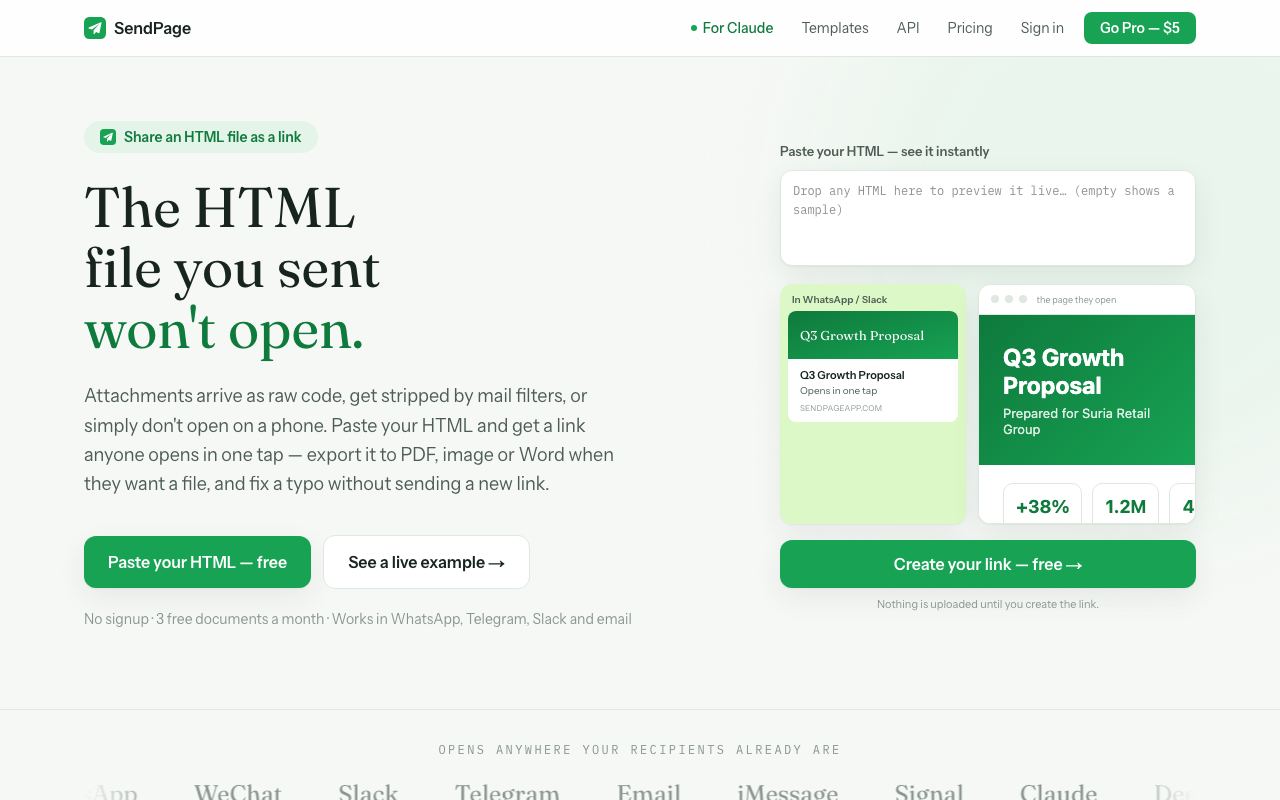
SendPage is a link-shortening and distribution service designed specifically for AI-generated HTML content, launched on Hacker News Show HN in August 2026. The tool solves a practical friction point: when AI models (ChatGPT, Claude, etc.) generate HTML—for landing pages, email templates, or product mockups—sharing the output typically requires either emailing raw code files, uploading to a web host, or deploying to a static site service. SendPage streamlines this by accepting HTML input and returning a shareable URL, hosting the page on SendPage's infrastructure. Users can paste AI-generated HTML or upload files, and the tool instantly generates a public link for distribution via email, Slack, or social media. The technical implementation is straightforward: SendPage stores HTML content on its servers and serves it as requested, likely with basic security measures such as rate limiting and abuse detection. No authentication, editing, or versioning is mentioned, suggesting a purely read-only distribution model. Pricing is unconfirmed, though the Show HN entry and consumer-facing design suggest either a free tier with limitations (e.g. link expiration, storage caps) or a freemium model with pro tiers. Use cases are clear: a copywriter uses GPT to draft a landing page in HTML, pastes it into SendPage, and emails the link to a client within seconds. A designer generates email template code via AI, shares it via SendPage for feedback without uploading to an email service provider. A startup validates a product mockup by sharing an AI-generated prototype page without setting up a domain or server. Compared to alternatives like Netlify Drop (drag-and-drop static deployment) or Vercel (Git-based deployment), SendPage removes the setup overhead entirely, trading automation for simplicity. Compared to pasting raw HTML into email, SendPage provides a browsable, professionally-presented view. Key limitations include lack of transparency on content persistence (how long are links stored before deletion?), no password protection or access controls, and inability to host dynamic content. The tool is also limited to HTML; interactive JavaScript features likely work, but server-side processing does not. Privacy and security terms are unconfirmed, leaving uncertainty about whether shared pages are indexed by search engines or visible to third parties.
Pros
- Eliminates need for web hosting, DNS configuration, or deployment pipelines to share HTML-based content, reducing friction for non-technical users
- Seamlessly integrates with AI text-to-HTML generation workflows, allowing one-click sharing of AI-generated landing pages, email templates, or documents
- URL-based distribution allows instant sharing via email, chat, or social media without requiring recipients to install software or create accounts
Cons
- Unclear whether shared pages are publicly indexed or discoverable, raising questions about link security and privacy expectations for sensitive content
- No published terms on link persistence, deletion policies, or archival guarantees; shared content longevity is unspecified
- Limited to HTML distribution; dynamic functionality, backend processing, or interactive features requiring server-side logic are likely not supported
Who it is for
- Best for: Marketers, copywriters, and designers who need to rapidly prototype and share AI-generated landing pages, email templates, or static documents with clients or stakeholders without managing hosting infrastructure..
- Avoid if: You require production-grade reliability, persistent storage guarantees, password protection for sensitive pages, or interactive features beyond static HTML and CSS..
Who this is for
SendPage is designed for freelance copywriters, marketing agencies, and independent designers who generate HTML via AI and need quick shareable links for client review. It suits content creators building one-off landing pages, email campaigns, and promotional materials, as well as startups validating product ideas with minimal infrastructure overhead.
Who should skip this
Teams requiring long-term content storage, organisations handling sensitive or confidential information, and anyone needing dynamic interactivity or backend integration should skip this tool. It is also unsuitable for production websites, e-commerce, or applications requiring user authentication and data persistence.
Verdict
SendPage is a lightweight, practically useful tool for the narrow but real use case of sharing AI-generated static HTML prototypes. Its zero-setup approach and tight integration with AI workflows make it genuinely convenient. However, lack of clarity on persistence, privacy, and feature scope means it is best suited to prototype and review workflows rather than production or sensitive content sharing.
User reviews
Real reader reviews — separate from WireTensors' own editorial rating above. Every submission is moderated before it appears here.
Loading reviews…
Write a review
SendPage FAQ
What is SendPage? +
SendPage is a link-shortening and distribution service designed specifically for AI-generated HTML content, launched on Hacker News Show HN in August 2026. The tool solves a practical friction point: when AI models (ChatGPT, Claude, etc.) generate HTML—for landing pages, email templates, or product mockups—sharing the output typically requires either emailing raw code files, uploading to a web host, or deploying to a static site service. SendPage streamlines this by accepting HTML input and returning a shareable URL, hosting the page on SendPage's infrastructure. Users can paste AI-generated HTML or upload files, and the tool instantly generates a public link for distribution via email, Slack, or social media. The technical implementation is straightforward: SendPage stores HTML content on its servers and serves it as requested, likely with basic security measures such as rate limiting and abuse detection. No authentication, editing, or versioning is mentioned, suggesting a purely read-only distribution model. Pricing is unconfirmed, though the Show HN entry and consumer-facing design suggest either a free tier with limitations (e.g. link expiration, storage caps) or a freemium model with pro tiers. Use cases are clear: a copywriter uses GPT to draft a landing page in HTML, pastes it into SendPage, and emails the link to a client within seconds. A designer generates email template code via AI, shares it via SendPage for feedback without uploading to an email service provider. A startup validates a product mockup by sharing an AI-generated prototype page without setting up a domain or server. Compared to alternatives like Netlify Drop (drag-and-drop static deployment) or Vercel (Git-based deployment), SendPage removes the setup overhead entirely, trading automation for simplicity. Compared to pasting raw HTML into email, SendPage provides a browsable, professionally-presented view. Key limitations include lack of transparency on content persistence (how long are links stored before deletion?), no password protection or access controls, and inability to host dynamic content. The tool is also limited to HTML; interactive JavaScript features likely work, but server-side processing does not. Privacy and security terms are unconfirmed, leaving uncertainty about whether shared pages are indexed by search engines or visible to third parties.
How much does SendPage cost? +
SendPage pricing: Pricing not publicly listed at time of review. Always confirm current pricing on the official site, as plans change.
Does SendPage have a free tier? +
Yes. SendPage offers a free plan or free credits you can use to evaluate it.
What is SendPage best for? +
Marketers, copywriters, and designers who need to rapidly prototype and share AI-generated landing pages, email templates, or static documents with clients or stakeholders without managing hosting infrastructure..
When should you avoid SendPage? +
Avoid SendPage if: You require production-grade reliability, persistent storage guarantees, password protection for sensitive pages, or interactive features beyond static HTML and CSS..
What are the main pros of SendPage? +
Eliminates need for web hosting, DNS configuration, or deployment pipelines to share HTML-based content, reducing friction for non-technical users; Seamlessly integrates with AI text-to-HTML generation workflows, allowing one-click sharing of AI-generated landing pages, email templates, or documents; URL-based distribution allows instant sharing via email, chat, or social media without requiring recipients to install software or create accounts.
What are the main cons of SendPage? +
Unclear whether shared pages are publicly indexed or discoverable, raising questions about link security and privacy expectations for sensitive content; No published terms on link persistence, deletion policies, or archival guarantees; shared content longevity is unspecified; Limited to HTML distribution; dynamic functionality, backend processing, or interactive features requiring server-side logic are likely not supported.
Does SendPage have an affiliate program? +
No public affiliate program is listed for SendPage at the time of review.
How is SendPage rated? +
WireTensors rates SendPage 3.7 out of 5, based on capability, value, and fit for its intended use case.
What category does SendPage fall under? +
SendPage is categorised under productivity on WireTensors.
When was this SendPage review last verified? +
This review was last verified on 2026-08-11 against the vendor's official site.
Reviewed by Arjun Mehta
Editorial lead overseeing WireTensors' research, sourcing and verification process
Last verified:
Sources
- SendPage — official website — verified