Google Gemini Embedding 2 review
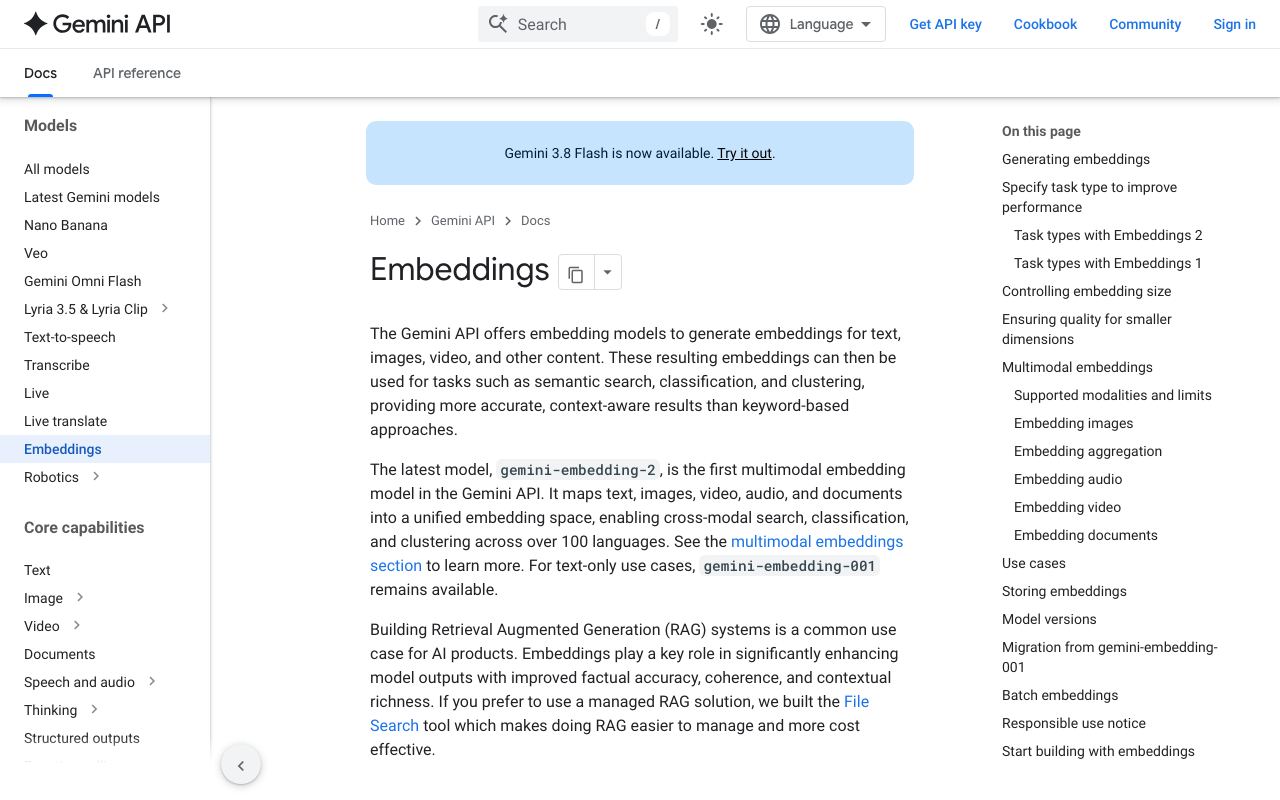
A multimodal embedding model that converts text, images, video, audio, and PDFs into unified vector representations for search and analysis.
WireTensors rating
Time saved: Saves approximately 3–5 hours per week on dataset indexing and search pipeline maintenance by eliminating need to manage separate text, image, and video embedding models..
Key facts
| Tool | Google Gemini Embedding 2 |
|---|---|
| Category | SEO |
| Pricing | Free via Google Cloud API |
| Free tier | Yes |
| WireTensors rating | 3.9 / 5 |
| Best for | Teams managing heterogeneous datasets (text, images, video, audio) who need semantic search and analysis across all modalities without building separate indexing pipelines. |
| Avoid if | You require single-modality embedding with guaranteed lowest latency, or you need embeddings for uncommon file formats and proprietary media types. |
| Affiliate commission | Pending affiliate program review |
| Cookie window | N/A |
| Last verified | 2026-06-30 |
Overview
Google Gemini Embedding 2 is a multimodal embedding model that transforms diverse content types—text, images, video, audio, and PDF files—into mathematical vectors (embeddings) in a unified vector space. Traditional embedding models handle single modalities: one model for text, another for images, another for audio. Gemini Embedding 2 consolidates this by learning a shared representation space where all modalities are comparable, enabling semantic search and similarity analysis across media types. For example, a user could search for "sunset over mountains" using text and receive ranked results including matching text documents, photographs, video clips, and audio descriptions—all scored by semantic relevance in the same embedding space. The underlying technology leverages Google's Gemini architecture, which has multimodal understanding built into its foundation. The embedding model is trained to project each modality (text, image, video, audio, PDF) into a common 768- or 1024-dimensional vector space. This allows cosine similarity and other vector distance metrics to work uniformly across modality boundaries. Google has trained the model on large-scale multimodal datasets, though specific training data composition and size are not publicly detailed. The model is accessed via Google's Generative AI API (ai.google.dev), which also powers other Gemini services, ensuring familiar authentication and integration patterns for Google Cloud users. Gemini Embedding 2 is currently free to use via the Google Cloud Generative AI API, with no announced premium tier as of June 2026. Rate limits and high-volume pricing are not yet fully documented, which creates uncertainty for teams planning production-scale deployments. The API charges compute resources and network egress in line with standard Google Cloud pricing, but embedding-specific costs (per-vector charges or monthly quotas) remain unclear. Developers can test the model immediately without sign-up friction, and integration with existing Gemini API clients is straightforward. Gemini Embedding 2 competes with multimodal embedding alternatives such as OpenAI's text-embedding-3 (text-only), Cohere's embedding API (text-only), and proprietary multimodal embeddings from cloud vendors. Few public benchmarks compare Gemini Embedding 2 directly to other multimodal options, which makes relative performance assessment difficult. The model's strength is its unified approach and Google Cloud integration; its limitation is the lack of production cost transparency and extensive third-party evaluation. Teams already invested in Google Cloud and Gemini for other tasks will find rapid adoption straightforward; others may encounter cost surprises at scale or prefer more battle-tested multimodal embedding services.
Pros
- Unified vector space handles five modalities (text, image, video, audio, PDF) in a single model, eliminating need for separate embedding services
- Significantly improves semantic search accuracy and dataset analysis by representing diverse content types in comparable mathematical spaces
- Native integration with Google Cloud ecosystem and existing Gemini API workflows
Cons
- Pricing and rate limits for high-volume embedding at production scale are not yet fully documented
- Multimodal representation may introduce latency compared to single-modality embedding models optimised for specific content types
- Limited public benchmarks or third-party evaluations comparing it to existing multimodal embedding alternatives
Who it is for
- Best for: Teams managing heterogeneous datasets (text, images, video, audio) who need semantic search and analysis across all modalities without building separate indexing pipelines..
- Avoid if: You require single-modality embedding with guaranteed lowest latency, or you need embeddings for uncommon file formats and proprietary media types..
Who this is for
SEO specialists, content strategists, and information architects working with multimedia datasets will find unified vector representations invaluable for semantic search and discovery. Data scientists and machine learning engineers building multimodal RAG systems, knowledge graphs, or content recommendation engines are primary users. Product teams at media companies, e-learning platforms, and search-focused businesses benefit from indexing and searching across text, images, and video simultaneously.
Who should skip this
Teams working exclusively with text or single-modality data should use purpose-built embedding models, which are typically faster and cheaper. Organisations locked into non-Google cloud providers or committed to vendor-independent infrastructure may prefer embedding models hosted on neutral platforms. Companies needing extremely high throughput with strict latency SLAs should benchmark Gemini Embedding 2 before committing, as production latency under load is not widely published.
Verdict
Gemini Embedding 2 addresses a real need for unified multimodal search and analysis by bringing five modalities into a single embedding space, making it valuable for teams managing diverse content. However, unclear production pricing, limited public benchmarks, and early-stage availability mean it is best suited to teams already committed to Google Cloud infrastructure and willing to test costs on small-to-medium workloads before scaling.
User reviews
Real reader reviews — separate from WireTensors' own editorial rating above. Every submission is moderated before it appears here.
Loading reviews…
Write a review
Google Gemini Embedding 2 FAQ
What is Google Gemini Embedding 2? +
Google Gemini Embedding 2 is a multimodal embedding model that transforms diverse content types—text, images, video, audio, and PDF files—into mathematical vectors (embeddings) in a unified vector space. Traditional embedding models handle single modalities: one model for text, another for images, another for audio. Gemini Embedding 2 consolidates this by learning a shared representation space where all modalities are comparable, enabling semantic search and similarity analysis across media types. For example, a user could search for "sunset over mountains" using text and receive ranked results including matching text documents, photographs, video clips, and audio descriptions—all scored by semantic relevance in the same embedding space. The underlying technology leverages Google's Gemini architecture, which has multimodal understanding built into its foundation. The embedding model is trained to project each modality (text, image, video, audio, PDF) into a common 768- or 1024-dimensional vector space. This allows cosine similarity and other vector distance metrics to work uniformly across modality boundaries. Google has trained the model on large-scale multimodal datasets, though specific training data composition and size are not publicly detailed. The model is accessed via Google's Generative AI API (ai.google.dev), which also powers other Gemini services, ensuring familiar authentication and integration patterns for Google Cloud users. Gemini Embedding 2 is currently free to use via the Google Cloud Generative AI API, with no announced premium tier as of June 2026. Rate limits and high-volume pricing are not yet fully documented, which creates uncertainty for teams planning production-scale deployments. The API charges compute resources and network egress in line with standard Google Cloud pricing, but embedding-specific costs (per-vector charges or monthly quotas) remain unclear. Developers can test the model immediately without sign-up friction, and integration with existing Gemini API clients is straightforward. Gemini Embedding 2 competes with multimodal embedding alternatives such as OpenAI's text-embedding-3 (text-only), Cohere's embedding API (text-only), and proprietary multimodal embeddings from cloud vendors. Few public benchmarks compare Gemini Embedding 2 directly to other multimodal options, which makes relative performance assessment difficult. The model's strength is its unified approach and Google Cloud integration; its limitation is the lack of production cost transparency and extensive third-party evaluation. Teams already invested in Google Cloud and Gemini for other tasks will find rapid adoption straightforward; others may encounter cost surprises at scale or prefer more battle-tested multimodal embedding services.
How much does Google Gemini Embedding 2 cost? +
Google Gemini Embedding 2 pricing: Free via Google Cloud API. Always confirm current pricing on the official site, as plans change.
Does Google Gemini Embedding 2 have a free tier? +
Yes. Google Gemini Embedding 2 offers a free plan or free credits you can use to evaluate it.
What is Google Gemini Embedding 2 best for? +
Teams managing heterogeneous datasets (text, images, video, audio) who need semantic search and analysis across all modalities without building separate indexing pipelines..
When should you avoid Google Gemini Embedding 2? +
Avoid Google Gemini Embedding 2 if: You require single-modality embedding with guaranteed lowest latency, or you need embeddings for uncommon file formats and proprietary media types..
What are the main pros of Google Gemini Embedding 2? +
Unified vector space handles five modalities (text, image, video, audio, PDF) in a single model, eliminating need for separate embedding services; Significantly improves semantic search accuracy and dataset analysis by representing diverse content types in comparable mathematical spaces; Native integration with Google Cloud ecosystem and existing Gemini API workflows.
What are the main cons of Google Gemini Embedding 2? +
Pricing and rate limits for high-volume embedding at production scale are not yet fully documented; Multimodal representation may introduce latency compared to single-modality embedding models optimised for specific content types; Limited public benchmarks or third-party evaluations comparing it to existing multimodal embedding alternatives.
Does Google Gemini Embedding 2 have an affiliate program? +
No public affiliate program is listed for Google Gemini Embedding 2 at the time of review.
How is Google Gemini Embedding 2 rated? +
WireTensors rates Google Gemini Embedding 2 3.9 out of 5, based on capability, value, and fit for its intended use case.
What category does Google Gemini Embedding 2 fall under? +
Google Gemini Embedding 2 is categorised under seo on WireTensors.
When was this Google Gemini Embedding 2 review last verified? +
This review was last verified on 2026-06-30 against the vendor's official site.
Reviewed by Arjun Mehta
Editorial lead overseeing WireTensors' research, sourcing and verification process
Last verified:
Sources
- Google Gemini Embedding 2 — official website — verified