Gemini Enterprise review
Secure AI platform enabling employees to interact with company data and build custom agents in a controlled environment.
WireTensors rating
Time saved: Saves approximately 5–8 hours per week on routine data queries, document analysis, and process automation tasks for knowledge workers, with greater savings in data-heavy roles like compliance and legal review..
Key facts
| Tool | Gemini Enterprise |
|---|---|
| Category | Productivity |
| Pricing | $30 per user per month |
| Free tier | No |
| WireTensors rating | 3.9 / 5 |
| Best for | Mid-to-large enterprises in regulated industries (healthcare, finance, legal) requiring secure, company-data-aware AI agents with audit trails and granular access control. |
| Avoid if | Your team is small, budget-constrained, or dependent on bespoke agent architectures; you require seamless integration with non-cloud legacy systems; you cannot commit to per-user subscription costs. |
| Affiliate commission | Pending affiliate program review |
| Cookie window | N/A |
| Last verified | 2026-07-01 |
Overview
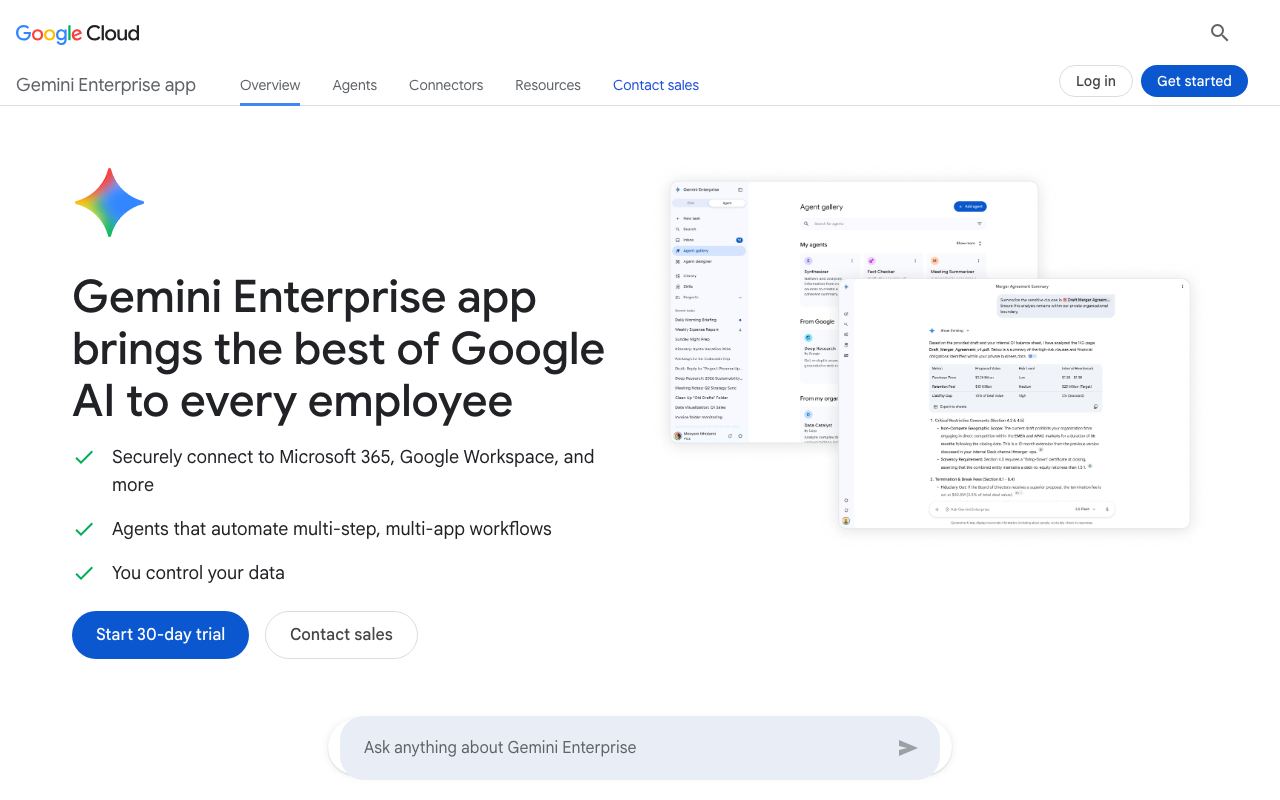
Gemini Enterprise, launched by Google in June 2026, is a managed platform providing organisations with secure, isolated AI agent capabilities powered by Google's Gemini models. The product is designed for enterprises requiring strict data governance, audit trails, and compliance with regulations such as HIPAA, GDPR, and SOC 2. Unlike public AI services, Gemini Enterprise does not use customer interactions to train public models; all inference occurs within a customer-controlled, air-gapped environment with optional data residency in specific geographic regions. The platform is built on Gemini's multimodal capabilities and allows employees to interact with company-specific data—documents, databases, internal knowledge bases—without uploading proprietary information to public cloud APIs. Google provides role-based access controls (RBAC), audit logging, and fine-grained permissions so that teams can restrict which employees can query which datasets. The agent-building interface includes visual workflows and predefined agent templates for common tasks such as document summarisation, FAQs, and data retrieval, reducing the need for custom development. Pricing is fixed at $30 per user per month, with transparent billing. There is no separate per-query or per-agent cost, making it easier for enterprises to forecast total cost of ownership. Organisations can provision as many custom agents as needed without additional licensing fees. Integration with on-premises data requires Google Cloud connectors or custom middleware; native support exists for data in BigQuery, Cloud Storage, and Google Workspace, but legacy enterprise systems (mainframes, on-premises SQL Server, Salesforce) may require API bridges. Gemini Enterprise's primary limitation is its per-user cost structure, which makes adoption expensive for large organisations with many non-technical staff. Agent customisation, whilst flexible for common use cases, may not support highly bespoke reasoning tasks or agentic workflows that require custom fine-tuning. Early customer case studies and detailed integration guides are limited, making it difficult to assess total implementation time and hidden integration costs. The product remains in early adoption; long-term roadmap commitments regarding model updates, pricing stability, and feature velocity are unclear.
Pros
- Transparent per-user monthly pricing reduces uncertainty and supports predictable cost forecasting for organisations
- Granular access controls and data residency options address compliance and security concerns for regulated industries
- Allows non-technical employees to build and deploy custom agents via low-code interfaces, reducing dependency on AI engineering teams
Cons
- Pricing tier excludes small teams and startups; $30/user/month accumulates quickly for organisations with many employees
- Integration with legacy enterprise systems may require custom middleware; not all on-premises data sources are natively supported
- Agent building capabilities appear limited to predefined templates; fully custom agent architectures may require external development
Who it is for
- Best for: Mid-to-large enterprises in regulated industries (healthcare, finance, legal) requiring secure, company-data-aware AI agents with audit trails and granular access control..
- Avoid if: Your team is small, budget-constrained, or dependent on bespoke agent architectures; you require seamless integration with non-cloud legacy systems; you cannot commit to per-user subscription costs..
Who this is for
Enterprise security and compliance officers, chief information security officers (CISOs), and IT operations leaders in regulated sectors. Gemini Enterprise also serves knowledge workers in legal, finance, and healthcare who need AI assistance on proprietary datasets without exposing data to public AI services. Business process optimisation teams use it to automate internal workflows whilst maintaining strict access controls and data governance.
Who should skip this
Startups and small businesses; organisations with primarily on-premises infrastructure; teams seeking free or freemium AI tooling; companies unwilling to commit to per-user subscription models; organisations without strong data governance and compliance requirements.
Verdict
Gemini Enterprise addresses a genuine market gap for regulated enterprises needing secure, company-data-aware AI agents with audit trails and compliance controls. The $30/user/month pricing is transparent but may limit adoption in cost-conscious organisations; suitability depends on data sensitivity requirements and budget allocation for per-user AI tooling.
User reviews
Real reader reviews — separate from WireTensors' own editorial rating above. Every submission is moderated before it appears here.
Loading reviews…
Write a review
Gemini Enterprise FAQ
What is Gemini Enterprise? +
Gemini Enterprise, launched by Google in June 2026, is a managed platform providing organisations with secure, isolated AI agent capabilities powered by Google's Gemini models. The product is designed for enterprises requiring strict data governance, audit trails, and compliance with regulations such as HIPAA, GDPR, and SOC 2. Unlike public AI services, Gemini Enterprise does not use customer interactions to train public models; all inference occurs within a customer-controlled, air-gapped environment with optional data residency in specific geographic regions. The platform is built on Gemini's multimodal capabilities and allows employees to interact with company-specific data—documents, databases, internal knowledge bases—without uploading proprietary information to public cloud APIs. Google provides role-based access controls (RBAC), audit logging, and fine-grained permissions so that teams can restrict which employees can query which datasets. The agent-building interface includes visual workflows and predefined agent templates for common tasks such as document summarisation, FAQs, and data retrieval, reducing the need for custom development. Pricing is fixed at $30 per user per month, with transparent billing. There is no separate per-query or per-agent cost, making it easier for enterprises to forecast total cost of ownership. Organisations can provision as many custom agents as needed without additional licensing fees. Integration with on-premises data requires Google Cloud connectors or custom middleware; native support exists for data in BigQuery, Cloud Storage, and Google Workspace, but legacy enterprise systems (mainframes, on-premises SQL Server, Salesforce) may require API bridges. Gemini Enterprise's primary limitation is its per-user cost structure, which makes adoption expensive for large organisations with many non-technical staff. Agent customisation, whilst flexible for common use cases, may not support highly bespoke reasoning tasks or agentic workflows that require custom fine-tuning. Early customer case studies and detailed integration guides are limited, making it difficult to assess total implementation time and hidden integration costs. The product remains in early adoption; long-term roadmap commitments regarding model updates, pricing stability, and feature velocity are unclear.
How much does Gemini Enterprise cost? +
Gemini Enterprise pricing: $30 per user per month. Always confirm current pricing on the official site, as plans change.
Does Gemini Enterprise have a free tier? +
No. Gemini Enterprise does not offer an ongoing free plan, though a trial may be available.
What is Gemini Enterprise best for? +
Mid-to-large enterprises in regulated industries (healthcare, finance, legal) requiring secure, company-data-aware AI agents with audit trails and granular access control..
When should you avoid Gemini Enterprise? +
Avoid Gemini Enterprise if: Your team is small, budget-constrained, or dependent on bespoke agent architectures; you require seamless integration with non-cloud legacy systems; you cannot commit to per-user subscription costs..
What are the main pros of Gemini Enterprise? +
Transparent per-user monthly pricing reduces uncertainty and supports predictable cost forecasting for organisations; Granular access controls and data residency options address compliance and security concerns for regulated industries; Allows non-technical employees to build and deploy custom agents via low-code interfaces, reducing dependency on AI engineering teams.
What are the main cons of Gemini Enterprise? +
Pricing tier excludes small teams and startups; $30/user/month accumulates quickly for organisations with many employees; Integration with legacy enterprise systems may require custom middleware; not all on-premises data sources are natively supported; Agent building capabilities appear limited to predefined templates; fully custom agent architectures may require external development.
Does Gemini Enterprise have an affiliate program? +
No public affiliate program is listed for Gemini Enterprise at the time of review.
How is Gemini Enterprise rated? +
WireTensors rates Gemini Enterprise 3.9 out of 5, based on capability, value, and fit for its intended use case.
What category does Gemini Enterprise fall under? +
Gemini Enterprise is categorised under productivity on WireTensors.
When was this Gemini Enterprise review last verified? +
This review was last verified on 2026-07-01 against the vendor's official site.
Reviewed by Arjun Mehta
Editorial lead overseeing WireTensors' research, sourcing and verification process
Last verified:
Sources
- Gemini Enterprise — official website — verified