Appaca review
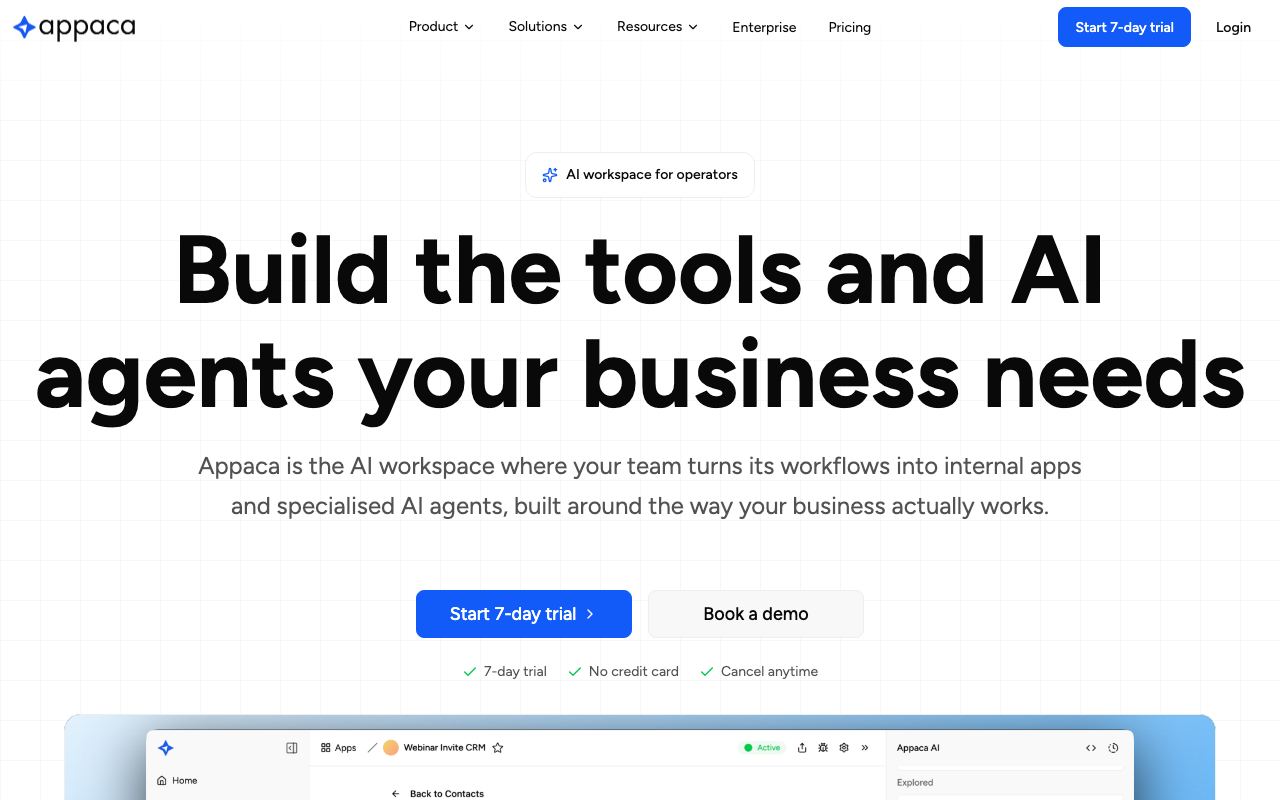
AI workspace platform for operators to build, deploy, and manage autonomous agents.
WireTensors rating
Time saved: Saves ~6–12 hours/week on agent configuration, monitoring, and troubleshooting by centralising operational control in a single interface..
Key facts
| Tool | Appaca |
|---|---|
| Category | Productivity |
| Pricing | Pricing not publicly listed at time of review |
| Free tier | No |
| WireTensors rating | 3.8 / 5 |
| Best for | Operations teams and workflow managers who need a unified interface to build, monitor, and adjust multiple AI agents in production environments. |
| Avoid if | You require extensive third-party integrations, formal compliance certifications, or established vendor support and SLAs. |
| Affiliate commission | Pending affiliate program review |
| Cookie window | N/A |
| Last verified | 2026-06-26 |
Overview
Appaca is an AI workspace platform designed for operators to build, deploy, and manage autonomous agents within a unified interface. Unlike generic agent frameworks or low-code workflow platforms, Appaca positions itself as an "operations workspace," prioritising the ongoing management and fine-tuning of agents post-deployment rather than just initial setup. The platform enables users to define agent behaviour visually, configure decision trees, and monitor agent performance from a centralised dashboard. The architecture appears to support multi-agent orchestration, where several agents can run in parallel, handle different task classes, or specialise in distinct domains. Operators can adjust agent behaviour, set constraints, review decisions, and intervene when agents encounter edge cases or decision ambiguity. This approach acknowledges that deployment is not the final step; maintaining and optimising agent performance requires ongoing human oversight. Appaca was highlighted on Hacker News as "Show HN: Appaca – AI Workspace for Operators," garnering discussion within the AI infrastructure community. The platform remains early-stage, with limited public pricing information and unclear integration pathways with enterprise systems. The product exists in a landscape populated by agent frameworks (LangGraph, AutoGen, Pipecat), orchestration platforms (n8n, Make), and cloud-native AI services. Appaca's differentiator is its focus on the "operator" role—the person managing agents in production rather than the developer building them. Current limitations include sparse documentation on supported LLM backends, agent types, and scalability characteristics. No formal security certifications or compliance frameworks have been published. The competitive position against established platforms like n8n (which support agent-like workflows) or versus purpose-built multi-agent platforms remains to be clarified as the product matures.
Pros
- Purpose-built workspace for operators managing multiple AI agents and workflows
- Enables visual agent construction and configuration without extensive coding
- Emphasis on operational oversight and agent management rather than just deployment
Cons
- Early-stage product with limited public information on pricing models and commercial terms
- Unclear integration capabilities with existing enterprise tools and systems
- No confirmed security certifications or compliance frameworks documented
Who it is for
- Best for: Operations teams and workflow managers who need a unified interface to build, monitor, and adjust multiple AI agents in production environments..
- Avoid if: You require extensive third-party integrations, formal compliance certifications, or established vendor support and SLAs..
Who this is for
Appaca is designed for operational professionals—workflow managers, automation engineers, and systems operators—who spend their day building and refining AI agent behaviour. Teams operating multiple concurrent agents and those needing visual configuration tools benefit most. DevOps-adjacent roles managing AI infrastructure, platform engineers building internal tools, and business operations teams automating repetitive processes are the primary audience.
Who should skip this
Non-technical business users should avoid this; it requires understanding of agent design and workflow architecture. Organisations requiring HIPAA, SOC 2, or other formal compliance should wait for certification. Teams entrenched in legacy RPA (robotic process automation) platforms or those preferring low-code/no-code platforms like Zapier may find the learning curve steep.
Verdict
Appaca addresses a genuine gap in the agent management space, targeting teams that need operational oversight of AI systems. However, its early-stage status, lack of public pricing, and limited documented integrations make it a tool for experimentation rather than immediate adoption. Teams evaluating it should request demo access and clarify roadmap priorities before committing to evaluation.
User reviews
Real reader reviews — separate from WireTensors' own editorial rating above. Every submission is moderated before it appears here.
Loading reviews…
Write a review
Appaca FAQ
What is Appaca? +
Appaca is an AI workspace platform designed for operators to build, deploy, and manage autonomous agents within a unified interface. Unlike generic agent frameworks or low-code workflow platforms, Appaca positions itself as an "operations workspace," prioritising the ongoing management and fine-tuning of agents post-deployment rather than just initial setup. The platform enables users to define agent behaviour visually, configure decision trees, and monitor agent performance from a centralised dashboard. The architecture appears to support multi-agent orchestration, where several agents can run in parallel, handle different task classes, or specialise in distinct domains. Operators can adjust agent behaviour, set constraints, review decisions, and intervene when agents encounter edge cases or decision ambiguity. This approach acknowledges that deployment is not the final step; maintaining and optimising agent performance requires ongoing human oversight. Appaca was highlighted on Hacker News as "Show HN: Appaca – AI Workspace for Operators," garnering discussion within the AI infrastructure community. The platform remains early-stage, with limited public pricing information and unclear integration pathways with enterprise systems. The product exists in a landscape populated by agent frameworks (LangGraph, AutoGen, Pipecat), orchestration platforms (n8n, Make), and cloud-native AI services. Appaca's differentiator is its focus on the "operator" role—the person managing agents in production rather than the developer building them. Current limitations include sparse documentation on supported LLM backends, agent types, and scalability characteristics. No formal security certifications or compliance frameworks have been published. The competitive position against established platforms like n8n (which support agent-like workflows) or versus purpose-built multi-agent platforms remains to be clarified as the product matures.
How much does Appaca cost? +
Appaca pricing: Pricing not publicly listed at time of review. Always confirm current pricing on the official site, as plans change.
Does Appaca have a free tier? +
No. Appaca does not offer an ongoing free plan, though a trial may be available.
What is Appaca best for? +
Operations teams and workflow managers who need a unified interface to build, monitor, and adjust multiple AI agents in production environments..
When should you avoid Appaca? +
Avoid Appaca if: You require extensive third-party integrations, formal compliance certifications, or established vendor support and SLAs..
What are the main pros of Appaca? +
Purpose-built workspace for operators managing multiple AI agents and workflows; Enables visual agent construction and configuration without extensive coding; Emphasis on operational oversight and agent management rather than just deployment.
What are the main cons of Appaca? +
Early-stage product with limited public information on pricing models and commercial terms; Unclear integration capabilities with existing enterprise tools and systems; No confirmed security certifications or compliance frameworks documented.
Does Appaca have an affiliate program? +
No public affiliate program is listed for Appaca at the time of review.
How is Appaca rated? +
WireTensors rates Appaca 3.8 out of 5, based on capability, value, and fit for its intended use case.
What category does Appaca fall under? +
Appaca is categorised under productivity on WireTensors.
When was this Appaca review last verified? +
This review was last verified on 2026-06-26 against the vendor's official site.
Reviewed by Arjun Mehta
Editorial lead overseeing WireTensors' research, sourcing and verification process
Last verified:
Sources
- Appaca — official website — verified