Alyph review
A tool for manual, fine-grained control over LLM context, allowing users to compose, edit, and optimise prompts and context windows for complex coding and reasoning tasks.
WireTensors rating
Time saved: Saves 5–8 hours per week for prompt engineers and researchers optimising model performance for specific tasks; minimal value for general coding workflows..
Key facts
| Tool | Alyph |
|---|---|
| Category | Coding |
| Pricing | Pricing not publicly listed at time of review |
| Free tier | Yes |
| WireTensors rating | 3.4 / 5 |
| Best for | ML researchers and prompt engineers debugging model behaviour and optimising context composition for complex multi-step reasoning tasks. |
| Avoid if | You are a software developer looking for a typical IDE or coding assistant; Alyph is a specialist tool for context engineering, not general-purpose coding. |
| Affiliate commission | Pending affiliate program review |
| Cookie window | N/A |
| Last verified | 2026-08-08 |
Overview
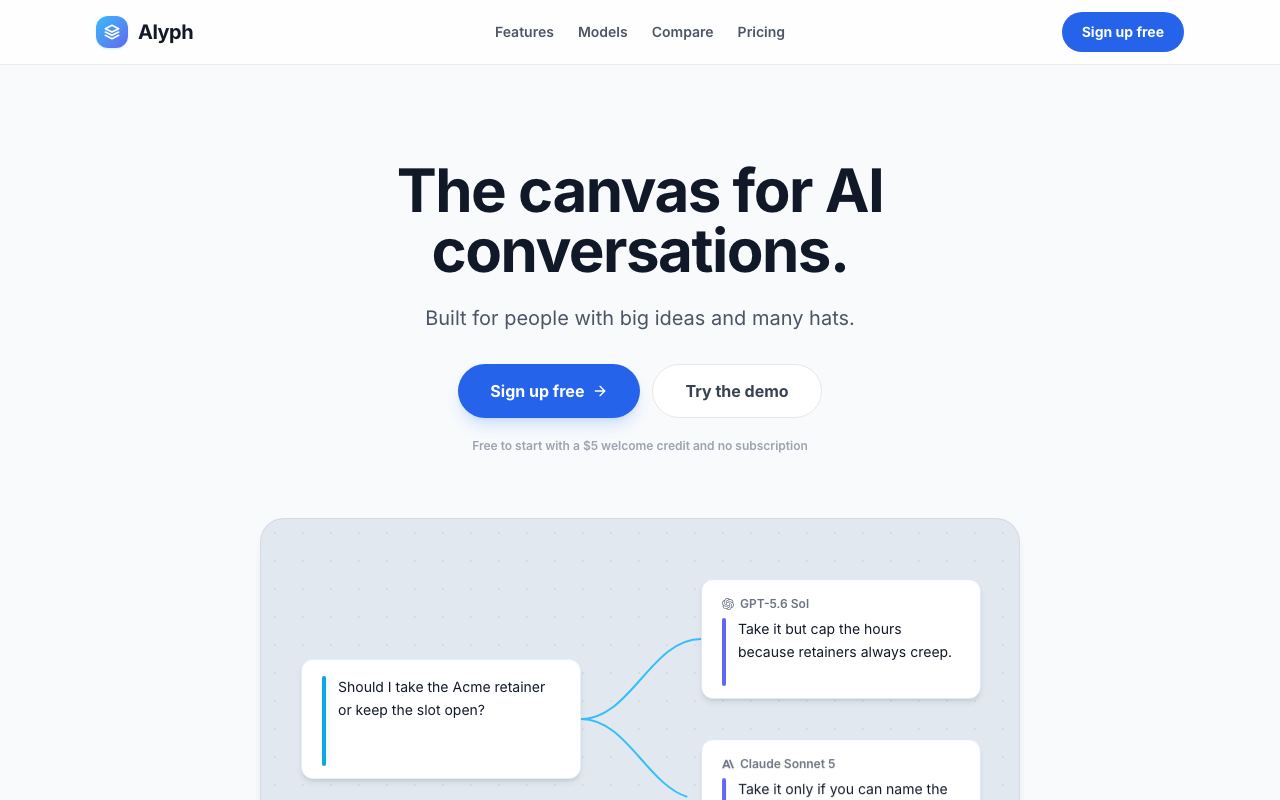
Alyph is a context composition and prompt engineering tool that provides manual, granular control over how input is structured and sent to large language models. The interface visualises a prompt as a sequence of components—system instructions, examples, retrieved documents, user queries—and allows users to edit, reorder, and refine each element independently. This visibility is valuable because most LLM interfaces (ChatGPT, Claude web) present a linear conversation, obscuring the underlying context structure that the model actually processes. Alyph exposes this structure, making it possible to diagnose why a model is ignoring instructions, conflating contexts, or producing unexpected outputs. Users can experiment with different context orderings, test how model output changes when an example is moved or removed, and iteratively optimise the composition for their specific task. The tool appears to integrate with multiple LLM APIs (likely OpenAI, Anthropic, others) rather than embedding a model itself, positioning it as a client-side orchestration layer. Pricing and business model are undisclosed; the product is in open beta or very early access. The interface is likely web-based, though deployment options (self-hosted, cloud, local) are not documented. Alyph's niche is narrow: it is designed for people who spend significant time optimising model behaviour, such as prompt engineers, safety researchers, and AI teams building production systems. For casual users or developers using AI as a supporting tool, the overhead of manual context composition is unlikely to justify the value gained. The 1-point Show HN reception suggests either very early discovery or limited organic enthusiasm, making it hard to assess whether the tool has found product-market fit.
Pros
- Addresses a real problem: most LLM interfaces hide context structure, making it hard to debug why a model produces suboptimal outputs
- Visual interface for composing and reordering context—similar to editing a manual transmission, as the marketing phrase suggests—provides transparency and control
- Supports iterative refinement of prompts and context without rewriting entire conversation histories
Cons
- Minimal public documentation or user testimonials; feature scope and ease-of-use are unvalidated
- Unclear how the tool integrates with existing coding workflows (IDEs, terminals) or if it is a standalone web interface only
- Early-stage market signal (1 point on Show HN) suggests very limited adoption or visibility
Who it is for
- Best for: ML researchers and prompt engineers debugging model behaviour and optimising context composition for complex multi-step reasoning tasks..
- Avoid if: You are a software developer looking for a typical IDE or coding assistant; Alyph is a specialist tool for context engineering, not general-purpose coding..
Who this is for
Prompt engineers, ML researchers, and AI safety engineers who need detailed visibility into how models process context and reasoning steps. Relevant to teams fine-tuning or evaluating models where context structure directly impacts output quality. Also applicable to data scientists building complex agent workflows where understanding model decision-making is critical.
Who should skip this
Generalist software developers should skip this—it adds layers of complexity for marginal gains unless you are actively debugging model behaviour. Teams without prompt-engineering expertise should wait for more polished UX and documentation. Organisations prioritising speed over introspection should avoid this; it is inherently a slow, deliberate tool designed for investigation rather than rapid iteration.
Verdict
Alyph addresses a legitimate need for prompt-engineering transparency and control, and its visual approach to context composition is a reasonable UX solution. However, the product is extremely early-stage, with minimal public validation or documentation. Organisations should consider it only if they have dedicated prompt-engineering roles and can tolerate an unfinished product. It may evolve into a valuable tool for AI teams, but current maturity is too low for general adoption.
User reviews
Real reader reviews — separate from WireTensors' own editorial rating above. Every submission is moderated before it appears here.
Loading reviews…
Write a review
Alyph FAQ
What is Alyph? +
Alyph is a context composition and prompt engineering tool that provides manual, granular control over how input is structured and sent to large language models. The interface visualises a prompt as a sequence of components—system instructions, examples, retrieved documents, user queries—and allows users to edit, reorder, and refine each element independently. This visibility is valuable because most LLM interfaces (ChatGPT, Claude web) present a linear conversation, obscuring the underlying context structure that the model actually processes. Alyph exposes this structure, making it possible to diagnose why a model is ignoring instructions, conflating contexts, or producing unexpected outputs. Users can experiment with different context orderings, test how model output changes when an example is moved or removed, and iteratively optimise the composition for their specific task. The tool appears to integrate with multiple LLM APIs (likely OpenAI, Anthropic, others) rather than embedding a model itself, positioning it as a client-side orchestration layer. Pricing and business model are undisclosed; the product is in open beta or very early access. The interface is likely web-based, though deployment options (self-hosted, cloud, local) are not documented. Alyph's niche is narrow: it is designed for people who spend significant time optimising model behaviour, such as prompt engineers, safety researchers, and AI teams building production systems. For casual users or developers using AI as a supporting tool, the overhead of manual context composition is unlikely to justify the value gained. The 1-point Show HN reception suggests either very early discovery or limited organic enthusiasm, making it hard to assess whether the tool has found product-market fit.
How much does Alyph cost? +
Alyph pricing: Pricing not publicly listed at time of review. Always confirm current pricing on the official site, as plans change.
Does Alyph have a free tier? +
Yes. Alyph offers a free plan or free credits you can use to evaluate it.
What is Alyph best for? +
ML researchers and prompt engineers debugging model behaviour and optimising context composition for complex multi-step reasoning tasks..
When should you avoid Alyph? +
Avoid Alyph if: You are a software developer looking for a typical IDE or coding assistant; Alyph is a specialist tool for context engineering, not general-purpose coding..
What are the main pros of Alyph? +
Addresses a real problem: most LLM interfaces hide context structure, making it hard to debug why a model produces suboptimal outputs; Visual interface for composing and reordering context—similar to editing a manual transmission, as the marketing phrase suggests—provides transparency and control; Supports iterative refinement of prompts and context without rewriting entire conversation histories.
What are the main cons of Alyph? +
Minimal public documentation or user testimonials; feature scope and ease-of-use are unvalidated; Unclear how the tool integrates with existing coding workflows (IDEs, terminals) or if it is a standalone web interface only; Early-stage market signal (1 point on Show HN) suggests very limited adoption or visibility.
Does Alyph have an affiliate program? +
No public affiliate program is listed for Alyph at the time of review.
How is Alyph rated? +
WireTensors rates Alyph 3.4 out of 5, based on capability, value, and fit for its intended use case.
What category does Alyph fall under? +
Alyph is categorised under coding on WireTensors.
When was this Alyph review last verified? +
This review was last verified on 2026-08-08 against the vendor's official site.
Reviewed by Arjun Mehta
Editorial lead overseeing WireTensors' research, sourcing and verification process
Last verified:
Sources
- Alyph — official website — verified